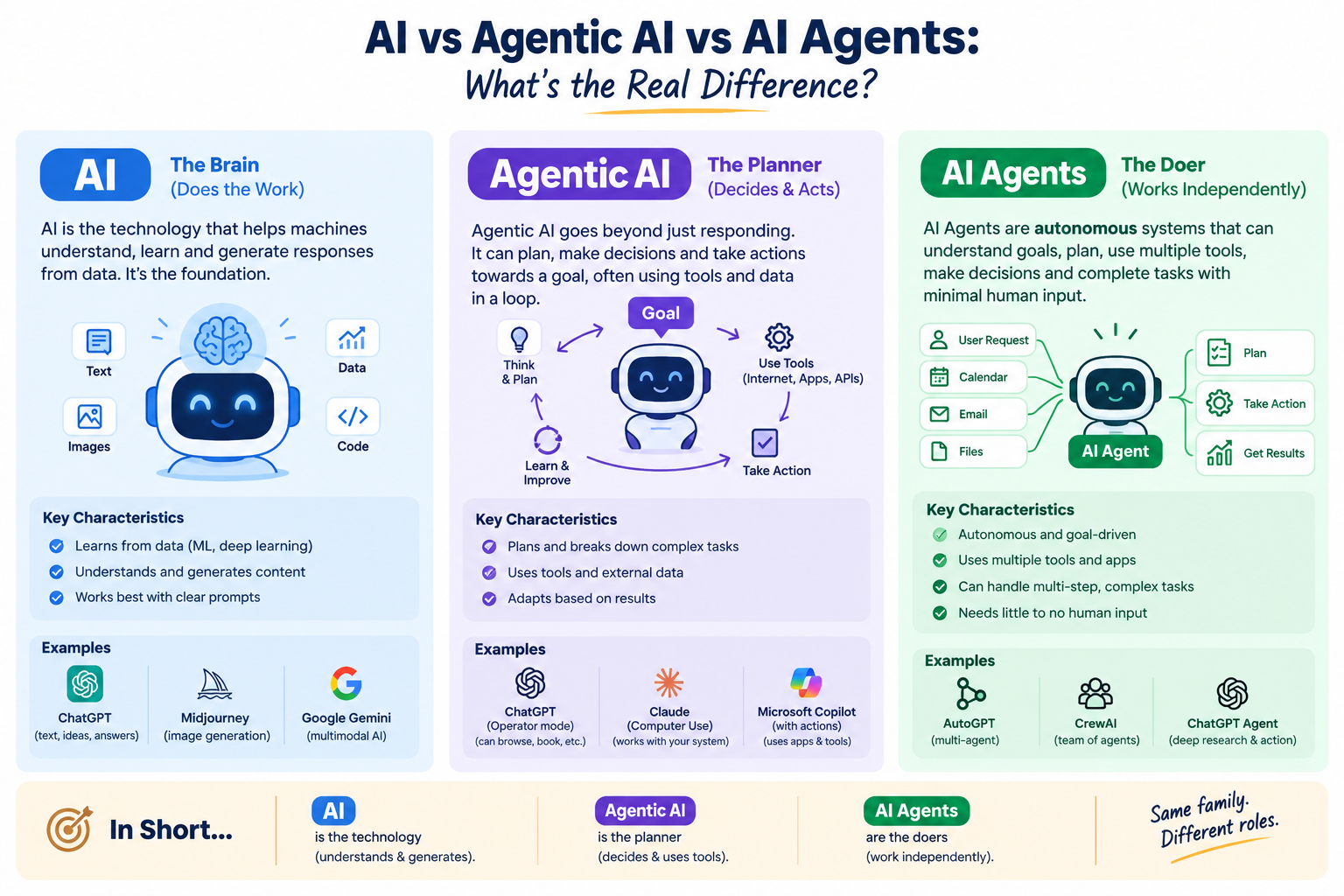
Quick answer: AI is the broad field of machines performing intelligent tasks. An AI agent is a single system that can perceive, decide, and act toward a goal, usually with some autonomy. Agentic AI is the broader approach or architecture of building multiple AI agents that plan, collaborate, use tools, and make decisions with minimal human input across a workflow. In short: AI is the category, an AI agent is the building block, and Agentic AI is the system built from those blocks.
This distinction matters more than ever in 2026, as businesses move from chatbots to autonomous systems that book meetings, write code, manage inventory, and run entire workflows without step-by-step human instructions. Below is a clear, practical breakdown of each term — what it means, how it works, and when to use it.
What Is AI?
Artificial Intelligence (AI) is the umbrella term for any system designed to simulate human-like intelligence — reasoning, learning, understanding language, or recognizing patterns. This includes everything from a spam filter to a recommendation engine to a large language model like the ones powering modern chatbots.
Key traits of traditional AI:
- Performs a specific, narrow task (classification, prediction, generation)
- Usually reactive — it responds when prompted or triggered
- Does not independently plan multi-step actions
- Examples: spam detection, image recognition, ChatGPT-style Q&A, recommendation algorithms
Traditional AI is powerful, but it’s fundamentally passive. It answers what you ask. It does not decide what to do next on its own.
Read: These 15 AI Tools Are Quietly Running Modern Businesses in 2026
What Is an AI Agent?
An AI agent is a step up from standard AI. It’s a system built around a model (often an LLM) that can:
- Perceive its environment or input (a question, a dataset, a trigger)
- Reason about what needs to happen
- Act using tools — searching the web, calling an API, writing code, sending an email
- Observe the result and adjust if needed
A single AI agent typically handles one well-defined job — a customer support agent, a coding assistant, a research agent that searches and summarizes. It has a degree of autonomy but usually operates within a bounded task and often loops back to a human for approval or final sign-off.
Example: A scheduling AI agent that reads your emails, checks your calendar, and proposes meeting times — without you telling it each individual step.
What Is Agentic AI?
Agentic AI refers to the broader architecture or paradigm where multiple AI agents — or a single highly autonomous agent with sub-agents — work together to complete complex, multi-step goals with minimal human oversight. It’s not one tool; it’s a system of coordinated, goal-driven agents.
Key traits of Agentic AI:
- Breaks a large goal into sub-tasks automatically
- Coordinates multiple specialized agents (a “planner,” a “researcher,” a “coder,” a “reviewer”)
- Makes decisions, corrects errors, and re-plans without constant human prompting
- Maintains memory and context across long, multi-step workflows
- Uses tools, APIs, and other software autonomously
Example: An agentic AI system tasked with “launch a marketing campaign” might autonomously research the audience, draft ad copy, generate images, schedule posts, monitor performance, and adjust the budget — all without a human directing each micro-step.
AI vs Agentic AI vs AI Agents: Side-by-Side Comparison
| Aspect | AI | AI Agent | Agentic AI |
| Scope | Broad field/technology | Single autonomous unit | System of coordinated agents |
| Autonomy | Low (reactive) | Medium (task-bound) | High (goal-driven, multi-step) |
| Decision-making | None or minimal | Makes decisions within a task | Plans, re-plans, and coordinates decisions |
| Human involvement | Constant prompting | Occasional oversight | Minimal, mostly goal-setting |
| Example | Text generator, image classifier | Customer support bot with tool access | Multi-agent system running end-to-end operations |
| Best for | Single-turn tasks | Defined, repeatable jobs | Complex, evolving workflows |
Why This Distinction Matters for Businesses
Choosing the wrong category can waste budget and create unrealistic expectations. A simple FAQ chatbot doesn’t need agentic architecture — a lightweight AI agent (or even plain AI) is enough. But automating an entire operations pipeline — lead qualification, follow-up, reporting, and escalation — needs genuine agentic AI with multiple cooperating agents and memory across the process.
Use plain AI when: you need a single response to a single input (summarization, classification, content generation).
Use an AI agent when: you need a task completed with some autonomy, using tools, but within a clear boundary (research assistant, coding copilot, support triage).
Use Agentic AI when: you need an entire multi-step workflow handled with minimal supervision, across tools, data sources, and decision points (autonomous operations, complex research pipelines, end-to-end automation).
Common Misconceptions
“Agentic AI and AI agents are the same thing.” Not quite — an AI agent is one component; agentic AI describes the overall system and philosophy of coordinating multiple agents autonomously.
“Agentic AI means fully unsupervised AI.” Most real-world agentic systems still include checkpoints, approvals, or guardrails for high-stakes actions. Autonomy is a spectrum, not a switch.
“More agents automatically means better results.” Poorly coordinated multi-agent systems can compound errors. Good agentic design depends on clear task decomposition, reliable tool use, and strong memory management — not just adding more agents.
Frequently Asked Questions
Q: Is ChatGPT an AI agent? A: On its own, a standard chatbot is closer to traditional AI — it responds to prompts. It becomes an AI agent when given tools, memory, and the ability to take multi-step actions toward a goal.
Q: What’s an example of agentic AI in real life? A: An autonomous system that manages a company’s customer lifecycle — qualifying leads, sending follow-ups, updating a CRM, and escalating issues — without a human directing each step.
Q: Do I need agentic AI for my business? A: Only if your workflow involves multiple interdependent steps, tools, and decisions. Simpler tasks are usually better served by a single AI agent or basic AI model.
Q: Which is more expensive to build — an AI agent or agentic AI? A: Agentic AI systems are generally more complex and costly, since they require coordination logic, memory systems, and multiple integrated agents rather than a single model call.
Key Takeaway
AI is the foundation, AI agents are autonomous task-doers built on that foundation, and Agentic AI is the coordinated system where multiple agents work together toward complex goals. Understanding this hierarchy helps you pick the right solution — instead of overbuying complexity you don’t need, or underestimating what a real workflow requires.